One room. One marker. One decision.

A guy with a Sharpie.

For leadership teams stuck on a decision that already has a date on it.

AI can produce more options, more summaries, more slides and more certainty-shaped language. It cannot take responsibility for the choice. Your leadership team still has to do that.

When the room keeps circling, I use questions, a marker and a whiteboard to make the real decision visible.

Book a 15-minute decision call

Tell me the decision. I’ll tell you whether a Sharpie Room can move it.

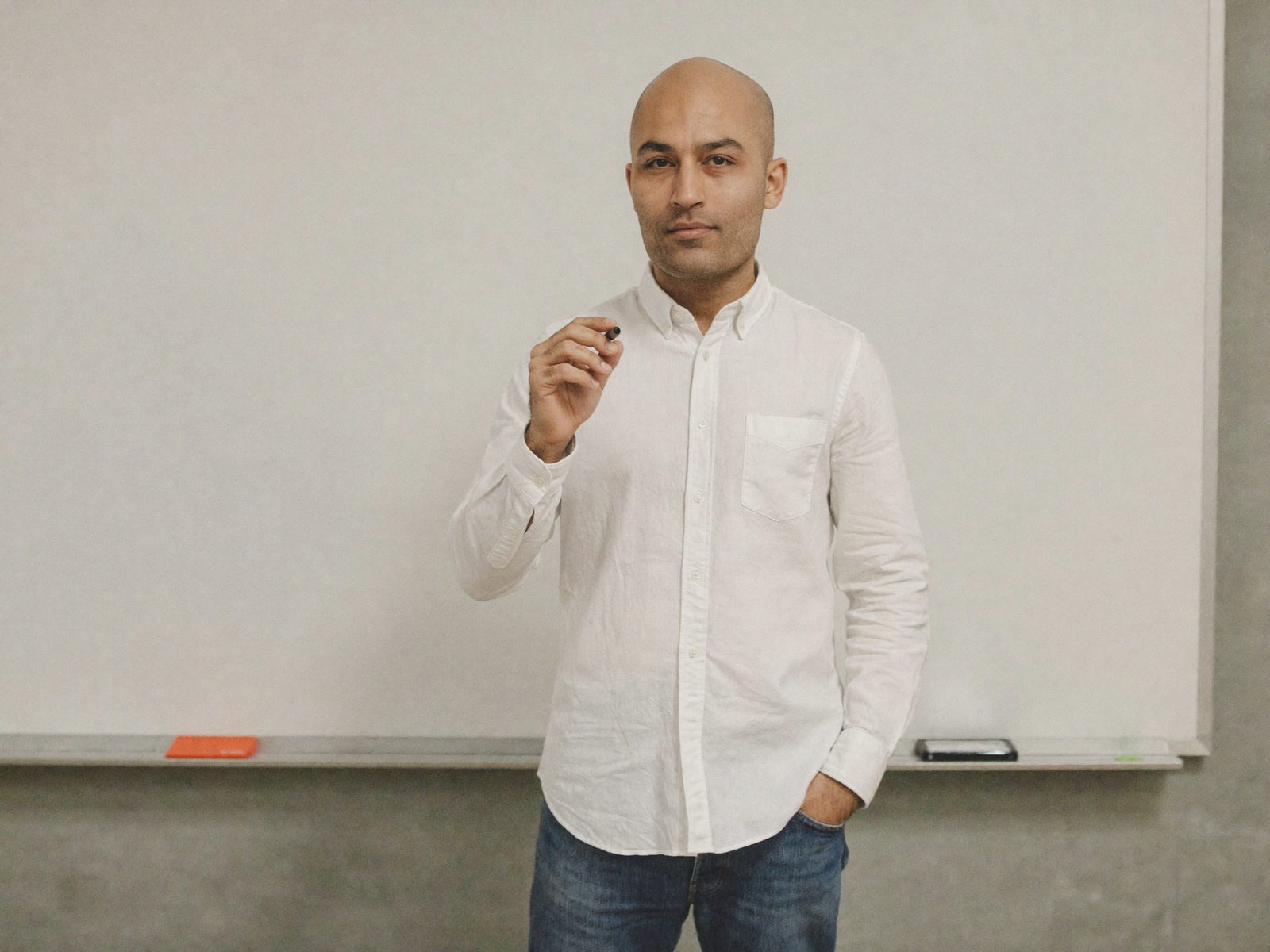
A person holding a marker in front of a whiteboard No deck.
Executive decision workshops by Paul Syng

Helped Deloitte win $2 billion in client work.

01 / The situation

Your team has had this conversation before.

Probably more than once.

Everyone has done the work. There is a deck. Behind that deck is another deck. Somewhere there is a model with three scenarios and a fourth tab nobody has opened.

The room still cannot land.

And producing more material has never been easier. AI can generate options, analysis, summaries and recommendations in minutes.

The hour you have to decide did not get any longer.

More material is giving the room more places to hide.

The diagnosis

You are probably not short of information.

Everyone in the room is intelligent. Everyone has a reasonable point of view.

But they are not answering the same question.

01 One person is solving for growth.
02 Another is protecting delivery.
03 Finance is working to a different time horizon.
04 Someone believes the decision has already been made.
The words sound compatible. The underlying pictures are not.

The offer

The
Sharpie
Room

Bring the real decision.

One focused executive session built around one consequential decision.

You bring the people who own it. I bring a marker.

I listen for the language hiding the issue. I ask the questions the room has stepped around. I draw the assumptions, constraints and competing versions of the problem where everyone can see them.

01
Make the actual decision visible.

Strip away the broad language and name the call the room has to make.

02
Put the disagreement on the wall.

Expose the different assumptions, interests, risks and time horizons underneath the discussion.

03
Face the trade-offs.

Make it clear what each path requires, what it rules out and who owns what happens next.

Not six issues.
Not a broad strategy day.
One decision.

02 / How it works

The work happens while the decision-makers are still in the room.

01

Before the room

We have one sponsor conversation.

You send what already exists: numbers, operating plans, research, proposals, emails or the documents that started the disagreement.

No survey. No team homework. No new deck.

Together, we reduce the brief to the decision the room must make.

02

In the room

I begin without a presentation.

We put the current question on the wall. Then I test it.

  • Is this the actual decision?
  • What does the money require?
  • What must be true for this option to work?
  • Whose risk are we protecting?
  • What are we unwilling to give up?
  • Who gets to decide?
03

After the room

You receive a one-page decision record within 48 hours.

  • The decision in plain language.
  • The reasoning behind it.
  • The trade-offs the room accepted.
  • What the team ruled out.
  • The owner and immediate next move.
  • Any condition that could change the decision.
03 / Artificial intelligence

Most AI programs stall in the same place.

Someone wants a platform. Someone wants agents. Someone read a deck on the plane. Nobody in the room has said what job the thing is meant to do.

The failure is rarely the model. It is that the thing was bought as a noun. An AI copilot. An agentic platform. A noun with no verb attached to it, so the licences get signed and the pilots quietly stall.

Enterprises do not buy identities. They buy outcomes.

So I start with the work rather than the tool. What your people actually do all day. Which parts need judgment, and which parts are moving something from one place to another.

The answer is usually smaller than what was proposed.

Five questions before anything gets built

01
What specific action does this enable?

Named as a verb somebody performs, not a capability the system has.

02
What baseline are we comparing against?

How the work gets done today, measured before anything changes.

03
What is the measured improvement?

A number against that baseline. Not a projection from a vendor.

04
How will the people using it verify that?

If only the project team can see the gain, it did not happen.

05
What is the timeline to value?

A date. Anything that cannot carry one is research, and that is a different budget.

Cannot answer all five? Then it is not ready to build.

At Deloitte I worked on the internal enablement platform used by roughly 16,000 people, on the strategy and the experience side. The problem there was never a shortage of information. It was surfacing the right thing at the moment somebody needed it, instead of burying it in a system they had to go and search. I have spent the last two years applying that same thinking to AI, in my own products and with clients.

People nod at decks. They argue with whiteboards.

A slide is a finished argument.

Its edges have been cleaned up. The language has been approved. The uncertainty has been removed before the room sees it.

That makes slides useful for presenting a decision. It makes them poor tools for making one.

A whiteboard is unfinished. People interrupt it, correct it, challenge it, stand up and redraw it.

The thinking stays visible while it changes.

That is the point.

My role

I am not the expert in your business.

Your people are.

I do not enter the room to replace their judgment with mine.

I enter without the history, departmental loyalty or need to defend the last recommendation. That distance lets me hear what the room cannot hear from inside itself.

The answer is often already there. It is buried under expertise, language, politics, old decisions and too much material.

My job is to help the room retrieve it.

Questions. A marker. A shared picture.

What people bring Paul in for

The method is listening, retrieval and simplification.

Not a prewritten answer. Not a performance of expertise. A way to help smart people see what they already know from a different angle.

Internal email, November 2021

“Yes he can design, but isn’t what you call a typical designer. Yes he can write, but isn’t a typical writer. And yes he helps develop strategies but isn’t a typical strategist. He is a swiss army knife of many skills but doesn’t easily fit into our typical tool box.”
“Let’s start to think of Paul as an option to help become a bridge between departments. The bridge between the complex and the creatives, or between account and strategy.”
Subtej Nijjar President, Mosaic North America
“He doesn’t apply his own personal vision. He seeks to clarify the client’s vision, listening and looking at challenges from different angles.”
Ryan James Terry Illustrator & Graphic Recorder
“Paul can sit in a room with experts from all manner of professions across a multitude of industries and facilitate creative problem solving.”
Noor Malik Director Digital, Mosaic North America
“Do yourself a favour and just let Paul ask you the questions you didn’t even know you had to consider.”
Preet Arjun Singh Founder, DesignX Community
“His integrated thinking kneads out the knots in your complex ideas.”
Deanna Andersen Managing Director, Partner at Accenture
04 / The refusals

What I will not do.

No slides.

You have enough finished arguments. The room needs somewhere to think in public.

No team homework.

Send me the material that already exists. I will not add another preparation project to the decision.

No deputies.

A room without the people who can decide produces another recommendation. You already have several of those.

No manufactured approval.

I will not run a session designed to create cover for a decision that has already been made.

No six-problem workshop.

The narrowness is the value. One consequential decision per room.

No forced consensus.

People can disagree with a decision and still understand it well enough to act.

05 / Fit

Bring the decision that keeps returning.

This is for you when

  • The issue has returned to the leadership table more than twice.
  • Several plausible options are competing for money, time or reputation.
  • Different functions are using the same words to mean different things.
  • Work has begun to branch because nobody has made the call.
  • More analysis is creating more options rather than more confidence.
  • The people with authority are willing to face the trade-offs.

This is not for you when

  • The missing piece is genuinely missing data.
  • The decision is already made and the room is meant to create cover.
  • The people with authority will not attend.
  • The team wants a general brainstorm or a wall of ideas.
  • Nobody is willing to rule anything out.
  • The goal is to revisit the issue again later.
“We have already done workshops.”

Most workshops are built to gather input. This one is built to make a decision.

There are no breakout exercises designed to create participation. No post-it wall that becomes a synthesis deck. No report arriving after the energy has left the room.

The work happens with the decision-makers present. So does the call.

“An outsider cannot understand our business in a day.”

Correct. I do not try to replace the expertise in the room.

Your people understand the business. What they cannot do is see their shared problem from outside the history that produced it. That distance is what I bring.

“Why analog?”

Because AI can help the team produce more material. It cannot make the team share one picture of the decision.

The whiteboard slows the thinking down enough to expose the assumptions. It keeps the reasoning public. And it makes it difficult to hide behind polished language.

“How is this different from hiring a strategy firm?”

A strategy engagement may be right when you need research, modelling, recommendations or a large body of work.

The Sharpie Room is for a narrower moment. The expertise is already present. The decision is not.

The next move

Bring me the decision.

You do not need a polished brief. You need a live issue, the people responsible for it and a willingness to make a choice.

Book 15 minutes

No presentation required.

Book a 15-minute decision call